Need Expert Tree Care?
Call Us Today at

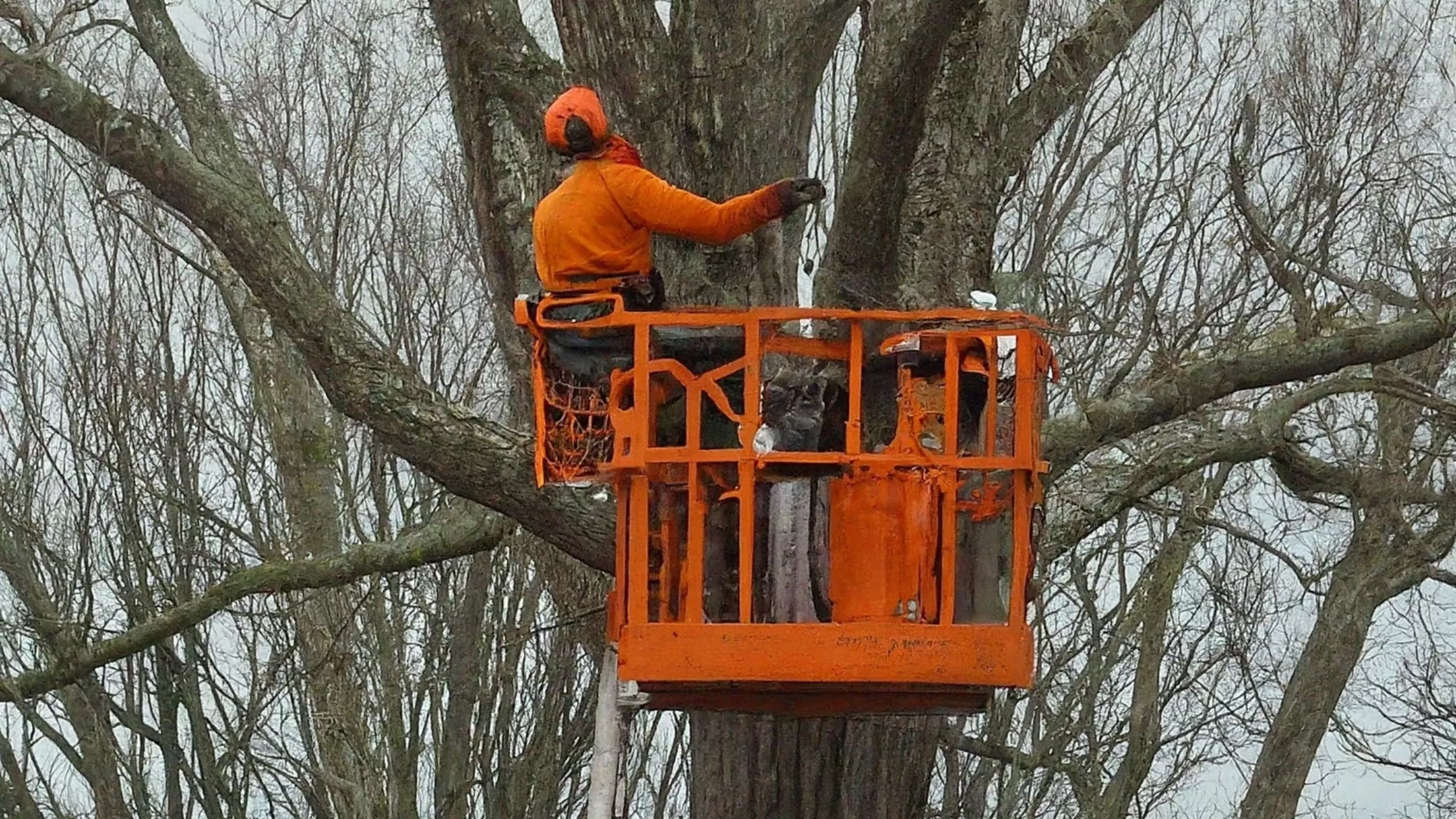
Removing a tree requires more than equipment. It requires structural evaluation, biological understanding, and careful planning to protect surrounding property.
Many properties in this area include mature hardwoods, ornamental plantings, and established canopy systems that deserve thoughtful consideration before removal begins.
Health & Hugs to Trees & Shrubs reflects our philosophy. Removal is never our first suggestion. We evaluate health, stability, and long-term landscape impact before determining whether a tree truly needs to come down.
While preservation is always preferred, certain conditions make removal the responsible and safe decision.
If structural pruning or corrective care can safely extend a tree’s life, we will recommend that first. Learn more about our Tree & Shrub Pruning Services.
Safe removal begins with planning and hazard mapping. Residential environments often require controlled dismantling rather than free-fall cutting.
Using aerial lifts and professional rigging equipment, sections are lowered with precision to minimize impact forces. This protects nearby structures and preserves the integrity of surrounding landscape features.
Tree removal decisions are based on structural science, not appearance alone. A tree may look healthy externally yet contain internal decay that compromises fiber strength. Conversely, a stressed tree may still be structurally sound.
Our arborists evaluate:
This evaluation ensures that removal is recommended only when stability, safety, or long-term viability is genuinely compromised.
Tree removal affects more than the individual tree. Root systems may intertwine with neighboring plantings. Soil structure can be impacted by equipment if not managed properly.
We implement protective measures including strategic equipment placement, minimal turf traffic routing, and controlled debris staging. The objective is to complete removal while preserving the overall health of the landscape.
For long-term resilience and preventative care, explore our Plant Health Care Services.
Changing weather patterns in Maryland have increased stress on many tree species. Extended summer heat, irregular precipitation, and fluctuating winter temperatures contribute to canopy decline and root vulnerability.
Stressed trees become more susceptible to secondary pests and fungal infections, which can gradually reduce structural reliability. Removal decisions must account not only for current appearance but projected stability under continued environmental pressure.
Removing a tree alters light patterns, airflow, and soil moisture distribution. These changes can create new planting opportunities while also increasing exposure for remaining trees.
Homeowners often consider:
If stump removal is desired, our Stump Grinding Services provide efficient site restoration.
Many tree failures do not happen suddenly. They develop gradually through stress cycles, root decline, internal decay progression, and shifting soil stability. Small warning signs — minor canopy thinning, fungal growth at the base, subtle lean changes, cracking soil near the root flare — often appear months or even years before structural failure occurs.
Identifying these indicators early allows for informed decision-making. In some cases, weight reduction pruning or structural support can meaningfully reduce risk. In others, removal becomes the responsible long-term solution before failure creates property damage or safety concerns.
Approaching removal as a preventative strategy rather than a reaction to visible collapse results in safer outcomes and more controlled planning.
On many established properties, tree canopies function as a connected system. One tree may shield others from prevailing winds, excessive sunlight, or soil moisture fluctuation. When a large tree is removed, surrounding trees can suddenly experience increased wind load and environmental exposure.
We evaluate neighboring canopy structure before and after removal to determine whether additional balancing or monitoring is appropriate. This broader ecosystem awareness helps protect the long-term stability of the entire landscape rather than focusing on a single tree in isolation.
No two properties present the same access challenges. Narrow side yards, sloped terrain, underground utilities, septic systems, and decorative hardscapes all influence equipment placement and dismantling strategy.
Before work begins, we assess:
Careful site planning reduces disruption and prevents unintended stress to lawns, irrigation systems, and adjacent plant material.
Tree removal should fit into a broader landscape plan rather than serve as a standalone action. Evaluating species diversity, age distribution, and overall canopy balance supports long-term property value and environmental resilience.
When removal is necessary, it presents an opportunity to reassess planting strategy and introduce species better suited to current climate conditions and soil characteristics. Thoughtful replacement planning strengthens the future canopy rather than simply subtracting from it.
Responsible removal is not about eliminating trees. It is about protecting safety, preserving landscape integrity, and supporting long-term stewardship.
Cost depends on tree size, access constraints, structural complexity, and equipment requirements. Each property is evaluated individually to ensure safe planning and accurate pricing.
In many cases, structural pruning or targeted health interventions can extend lifespan. We assess all preservation options before recommending removal.
When performed using controlled dismantling techniques and proper equipment planning, disruption can be minimized significantly.
Yes. Sectional removal using rigging systems and aerial lifts allows precise lowering of limbs and trunk sections to reduce structural risk.
Don’t settle for basic tree cutting.
If you need professional tree removal in Darnestown, MD, choose a team that evaluates thoroughly and removes responsibly.
A1 Tree Pros provides detailed on-site assessments and preservation-first recommendations throughout Montgomery County.